Strategy
Using AI to link disparate systems
Natural language is turning out to be the cheapest glue between CRM, ticketing, knowledge bases, and sales tools. Here's where it works and where it doesn't.

The problem
Data lives in silos. Your CRM holds deals and contacts. Your ticketing system holds support cases. Your knowledge base holds articles and FAQs. Email, spreadsheets, project tools: each in its own place. No single view.
When someone asks "what's the status of Acme Corp?" you might check three systems. When a support agent needs context on a customer, they switch between tabs. When sales wants to know which accounts have open tickets, they ask support. It's slow, error-prone, and doesn't scale.
What AI can do
Natural language becomes the glue. Instead of logging into each system and running separate queries, you ask in plain English: "show me all open deals for Acme Corp and any support tickets from the last 30 days." The AI pulls from CRM, ticketing, and (if connected) email. One question, one answer.
This isn't magic. It's AI that understands your question, maps it to the right APIs, fetches the data, and presents it usefully. The value is the integration: one interface across many systems.
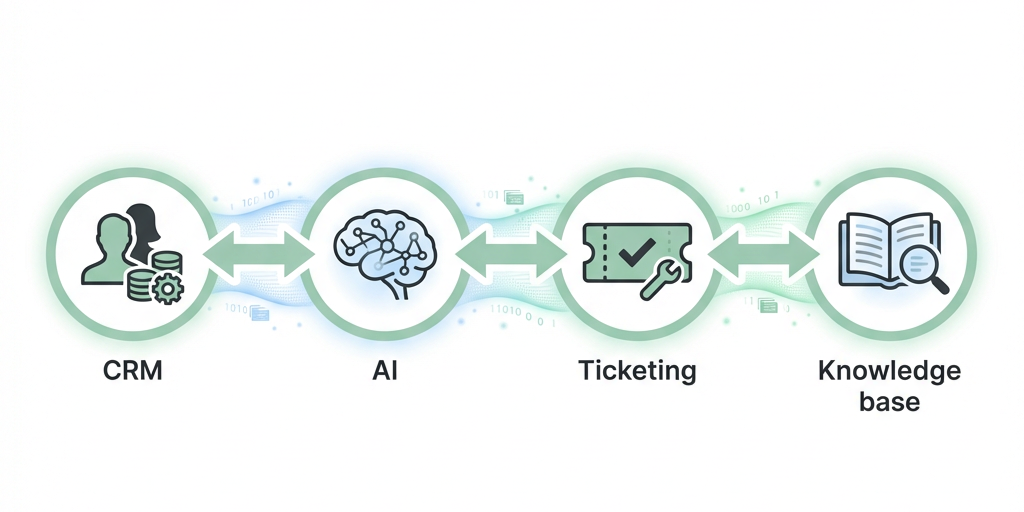
Example integrations
- CRM + ticketing: "which accounts have more than 5 open tickets?" or "what deals are at risk based on recent support escalations?"
- CRM + knowledge base: "find articles relevant to this customer's industry" or "what solutions have we documented for this product issue?"
- Sales tools + Office: "summarise the last three emails with this prospect" or "draft a follow-up based on our meeting notes and their LinkedIn."
The pattern is the same: connect the systems, define the queries, let natural language do the work of joining the dots.
Where it doesn't work
Integration isn't free. You need APIs that talk to each system. Authentication (OAuth, API keys, or service accounts) for each. You need to map data: how does "Account" in your CRM relate to "Customer" in your ticketing system? And every AI query consumes tokens, so high-volume, cross-system lookups add up.
There's also maintenance. APIs change. Vendors deprecate endpoints. Your integration needs to evolve, or you'll be fixing it every quarter.
When it pays off
- Volume is high: you're doing the same lookups repeatedly. Automating them saves real time.
- Workflows are cross-team: sales needs support data. Support needs sales context. One interface reduces handoffs.
- Data is already structured: CRM and ticketing have APIs. The hard part is connecting them, not cleaning messy data.
A handful of cross-system lookups a week: the ROI probably doesn't justify the build. Dozens a day: it usually does.